

BEQI In Action
Childcare Provider Voices: Lessons from BEQI: Together in Practice
What happens when quality improvement meets the realities of daily practice?
Insights from childcare providers in Nebraska using BEQI: Together in Practice.

A Partnership to Strengthen Early Childhood Practice in Nebraska
Since 2019, ECD Measure has partnered with the Nebraska Early Childhood Collaborative (NECC) to strengthen evidence-based practices in early childhood programs across Nebraska using the BEQI observation tool.
In 2025-2026, this partnership expanded with the launch of BEQI: Together in Practice (TIP) - a mentoring approach that pairs observation with strengths-based feedback and ongoing support delivered through simple technology.
The reflections below highlight what providers experienced when quality measurement was paired with practical support.
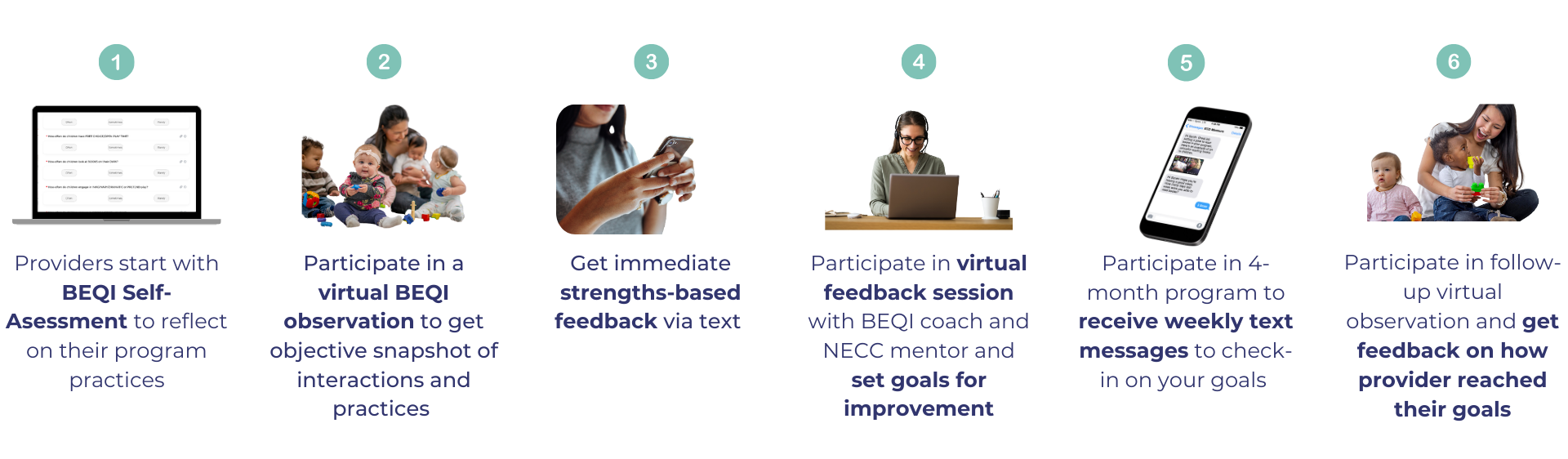
How the NECC BEQI : TIP Program Works

Five Lessons for Designing Practical Quality Improvement Systems
Through conversations with providers participating in BEQI: Together in Practice, the following five design principles emerged.

Lesson 1: Measurement must connect to support
“Once you're licensed, there’s not a lot of guidance on how to become better.”
Many early childhood systems rely on licensing, monitoring, and periodic assessments to signal quality. These mechanisms are important for ensuring standards, but they often provide limited guidance on how educators can strengthen their daily practice.
Chelsea’s reflection highlights the value of pairing measurement with practical support. When observation data is combined with timely feedback and ongoing guidance, it helps providers translate quality standards into concrete, manageable improvements in their classrooms.
BEQI: Together in Practice was designed to connect observation data with ongoing feedback and mentoring that support improvement in everyday practice.
Lesson 2: Improvement must be embedded in practice
“Having a new set of eyes come into my program - giving me ideas that weren’t just another training - made all the difference.”
Professional development is widely used to strengthen early childhood programs, yet educators are often expected to translate training into practice on their own. Without ongoing support, it can be difficult to consistently apply new ideas in busy classroom environments.
Dayna’s experience highlights the importance of support that is embedded in daily practice. When feedback and mentoring are connected to educators’ own goals and routines, professional learning becomes something that unfolds over time rather than a one-time event.
BEQI: Together in Practice supports this approach by providing ongoing, goal-aligned guidance that helps educators translate new ideas into everyday practice.
Lesson 3: Change must be manageable
“Sometimes you get in the run of everyday things, and the TIPS remind you not to be on autopilot anymore.”
Early childhood classrooms are high-cognitive-load environments. Educators manage routines, learning activities, and children’s needs simultaneously throughout the day, leaving little space for large or complex improvement initiatives.
Behavioral science shows that people are more likely to adopt new practices when change focuses on a small number of achievable actions. Lissett’s reflection illustrates how simple reminders and focused goals helped her stay intentional and make manageable improvements in her practice.
BEQI: Together in Practice reinforces this principle by helping educators focus on small, achievable shifts that build over time.
Lesson 4: Systems must be strengths-based
“The program reminded me I was already on the right track.”
Quality improvement efforts often focus primarily on identifying gaps in practice. While identifying areas for improvement is important, research suggests that change can be more sustainable when systems also recognize and build on educators’ strengths.
Ann’s experience highlights the role of strengths-based feedback in supporting growth. By reinforcing effective practices already present in the classroom, improvement becomes a process of building on what educators are doing well.
BEQI: Together in Practice uses strengths-based feedback to help educators recognize effective practices and build on them over time.
Lesson 5: Focus on observable behaviors
“Before I used to say ‘Good job.’ Now I say ‘Look at you — you know your colors.’”
Many aspects of teaching quality are expressed through everyday interactions between educators and children. These small moments—how educators respond to children’s ideas or describe what children are doing—play an important role in supporting learning.
Gwladys’ reflection shows how a simple shift in language can encourage children to think, speak, and engage more deeply. When quality improvement systems focus on observable teaching behaviors, small changes in everyday interactions can meaningfully strengthen learning.
BEQI: Together in Practice focuses feedback on practical teaching behaviors that educators can strengthen in daily interactions with children.

What We Learned…
Effective quality improvement systems:
Connect measurement with mentoring
Can be light-touch and delivered virtually
Embed improvement into everyday practice
Focus on manageable changes
Reinforce educator strengths
Support practical teaching behaviors
The experiences shared by these childcare providers highlight a broader lesson: quality improvement works best when systems support educators in the reality of their daily practice.
BEQI: Together in Practice was designed with that principle in mind.

We are grateful to the Nebraska Early Childhood Collaborative and the childcare providers across Nebraska who generously shared their experiences and helped inform this work.
GET IN TOUCH
Contact Us Today
Learn more about how we can support your organization's goals. Together, we can build a brighter future for young children everywhere.
